
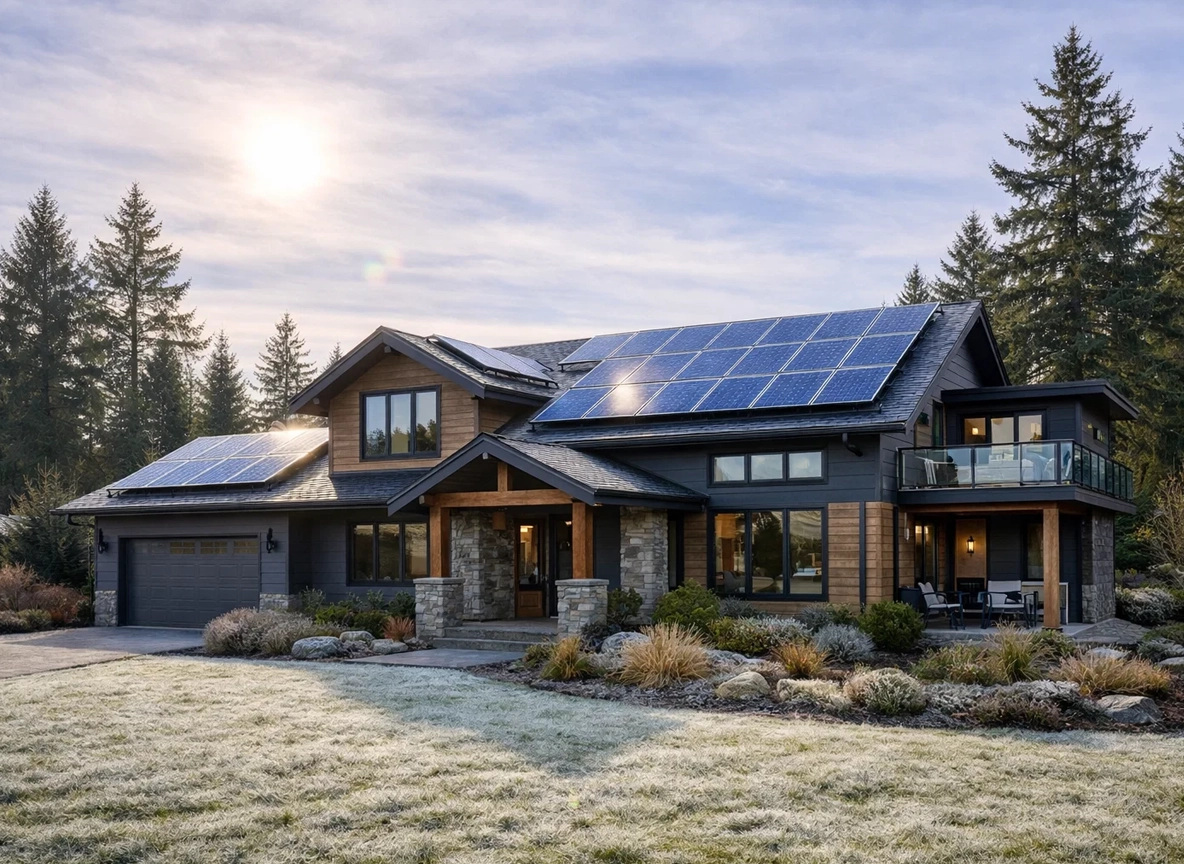
When people think about solar energy, they often picture bright sunshine and cloudless skies—conditions more commonly associated with the Southwest than the Pacific Northwest. It’s a fair assumption, but it also leads many Washington homeowners to underestimate the value of solar. The reality is that solar panels can still be a smart, cost-effective investment in Washington State, even during the winter months when days are shorter and skies are often overcast.
Here’s the Deal
It’s important to understand how solar panels actually work. Solar panels generate electricity from daylight, not heat. While direct sunlight produces the highest output, panels still generate power on cloudy days by capturing diffuse light that passes through cloud cover. Washington’s winters may be gray, but daylight hours still provide plenty of usable solar energy—and modern panels are designed to perform efficiently in these conditions.
In fact, cooler temperatures can improve panel efficiency. Solar cells tend to operate more effectively in cooler weather than in extreme heat, which can reduce electrical resistance. That means crisp winter days can partially offset shorter daylight hours. Over the course of a full year, Washington homeowners often find that spring, summer, and fall production balances out the winter dip, resulting in solid annual energy output.
Additional Solar Benefits in Washington
Net metering is another reason solar continues to make sense in Washington. Excess electricity generated during sunnier months can be sent back to the grid, earning credits that help offset energy use during darker winter periods. This annual balancing effect allows homeowners to benefit from solar year-round, even if winter production alone doesn’t cover all household demand.
Beyond energy production, financial incentives strengthen the case. Federal tax credits, potential state or local incentives, and long-term utility savings all contribute to solar’s return on investment. Even in regions with less sun exposure, these factors can significantly reduce payback periods. Over time, solar panels can stabilize energy costs, protect against utility rate increases, and add value to a home.
Considerations
All that said, solar performance in Washington depends heavily on proper system design and installation. Roof orientation, pitch, shading from trees or nearby structures, and panel placement all play a major role in how much energy a system produces. A professional installer from our team will assess these factors, run accurate production estimates, and design a system sized appropriately for the home’s energy needs and local climate.
Professional installation is also critical for safety, code compliance, and long-term reliability. Licensed Barron solar contractors ensure that electrical connections, mounting hardware, and roof penetrations are installed correctly and weatherproofed. Poor installation can lead to reduced performance, roof leaks, or costly repairs down the road—risks that easily outweigh any short-term savings from cutting corners.
In Washington’s shorter days, solar isn’t about chasing perfect conditions—it’s about smart design, realistic expectations, and professional execution. With the right system and expert installation, winter sun can still deliver real savings, making solar a practical and forward-thinking investment for Washington homeowners.
Our team of Home Performance Experts has served the I-5 corridor from Blaine to Marysville, Oak Harbor to Concrete, and the San Juan Islands since 1972 with a mission of Improving Lives™. We look forward to serving you too! Contact Barron Solar today for comprehensive solar support.